
Texas Booking Release Records
Texas booking releases are public records that show who has been booked into a county jail and when they left. Each of the state's 254 counties runs its own jail and keeps its own records. Most counties publish some form of online inmate roster or booking log. If you need to find out whether someone was recently arrested, confirm a release date, or check a current jail roster, Texas gives you several ways to search through official county and state sources.
Texas Booking Releases at a Glance
What Are Texas Booking Releases
A booking record is created when a person enters a county jail. Jail staff collect the person's name, date of birth, race, sex, charges, bond amount, and arresting agency. That data forms the booking entry. A release record shows when the person left, whether through bond payment, case dismissal, transfer to state custody, or completion of a sentence. Texas has no single statewide database for county-level booking releases. Each county sheriff manages its own records system and decides how much of that data to publish online.
Under the Texas Public Information Act, Government Code Chapter 552, basic arrest and booking data is public. The law requires release of the arrested person's name, age, address, race, sex, date and place of arrest, and the offense charged. Booking photos and bond amounts are also public in most cases. Government bodies must respond to records requests within 10 business days. You do not need to state a reason for your request, and the law applies to anyone, not just Texas residents.
One important distinction: county jails and state prisons are separate systems. County jails hold people who are awaiting trial or serving short sentences. State prisons hold people convicted of felonies with sentences longer than one year. Knowing which system applies to the person you are searching for will save you a lot of time.
Texas Department of Criminal Justice Inmate Records
The Texas Department of Criminal Justice at tdcj.texas.gov manages the state prison system and is the central portal for finding offenders in state facilities.

The TDCJ website links to the inmate search tool, parole resources, and unit contact information for every facility in the state prison system.
The Texas Department of Criminal Justice (TDCJ) oversees state prisons and parole supervision across Texas. It handles inmates serving sentences in state facilities, not county jails. TDCJ operates more than 100 correctional units. The agency also runs the Board of Pardons and Paroles, which decides when eligible offenders can be released to community supervision.
The TDCJ Offender Search at offender.tdcj.texas.gov lets you look up inmates by last name, first name, TDCJ number, or State Identification Number. Results include the offender's current unit or parole office, projected release date, offense history, and parole eligibility. You can also email inquiries to classifyandrecords@tdcj.texas.gov with the inmate's full name and seven-digit TDCJ number. The inmate locator phone line is (936) 295-6371 or (800) 535-0283. For parole status before a Board vote, call (844) 512-0461. After a Board vote, call (512) 406-5202.
TDCJ's main office in Huntsville is at 861-B I-45 North, Huntsville, Texas 77320. Their Austin office is at 209 West 14th Street, Austin, Texas 78701. Phone for the Austin office: (512) 463-9988.
Texas Commission on Jail Standards
The Texas Commission on Jail Standards regulates all county jails in Texas, setting and enforcing minimum standards for construction, operations, inmate care, and safety at all 254 county facilities.

TCJS conducts on-site inspections of every county jail in Texas and provides technical assistance to local jail administrators on standards compliance and operations.
The Texas Legislature created the Texas Commission on Jail Standards (TCJS) in 1975. Its mission is to ensure that all county jail facilities are safe, secure, and suitable through proper rules and procedures. The Commission operates under Government Code Chapter 55. Related rules are in Chapters 351 and 361 of the Local Government Code and Title 37 of the Texas Administrative Code. TCJS enforces more than 600 individual standards that cover everything from cell size to inmate medical care to training requirements for jail staff. Contact TCJS at 300 W. 15th Street, Suite 503, Austin, Texas 78711, phone 512.463.5505, or email info@tcjs.state.tx.us.
The TCJS monthly jail population reports are a useful data source for understanding booking patterns across the state. Each county sheriff submits a monthly count within five days of the end of the reporting period. The sheriff certifies the accuracy of the report.
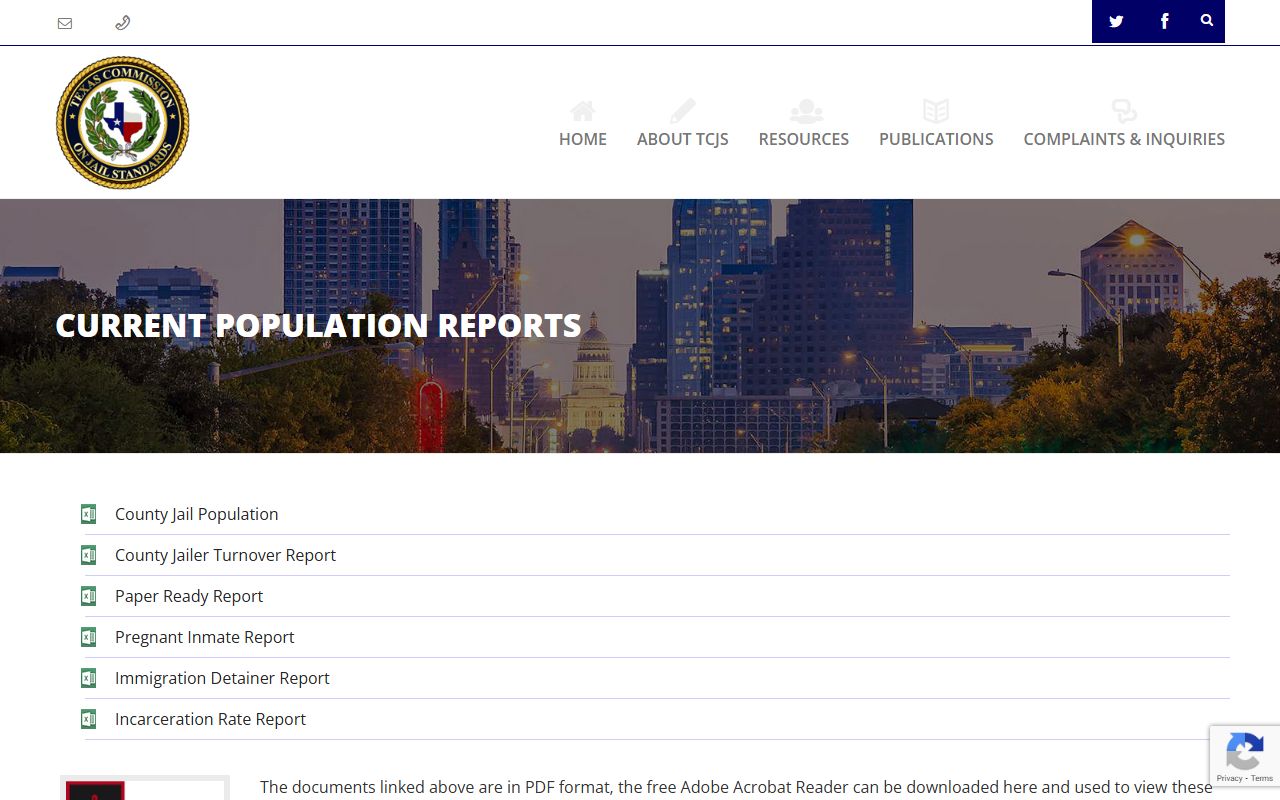
The TCJS population reports include breakdowns by felony vs. misdemeanor, pretrial vs. sentenced, male vs. female, and immigration detainer counts for every county in the state.
As of 2024, Texas county jails hold roughly 53,700 people in pretrial detention on any given day. The average daily population statewide runs about 65,000. Facilities overseen by TCJS process over one million bookings each year. The average daily cost per inmate was $62.41 as of August 2024. These figures reflect the scale of the county jail system and why the state maintains oversight through a dedicated regulatory agency.
DPS Crime Records and Texas Booking History
The Texas DPS Crime Records Division manages criminal history data and maintains the statewide criminal history database compiled from courts and law enforcement agencies across all 254 counties.
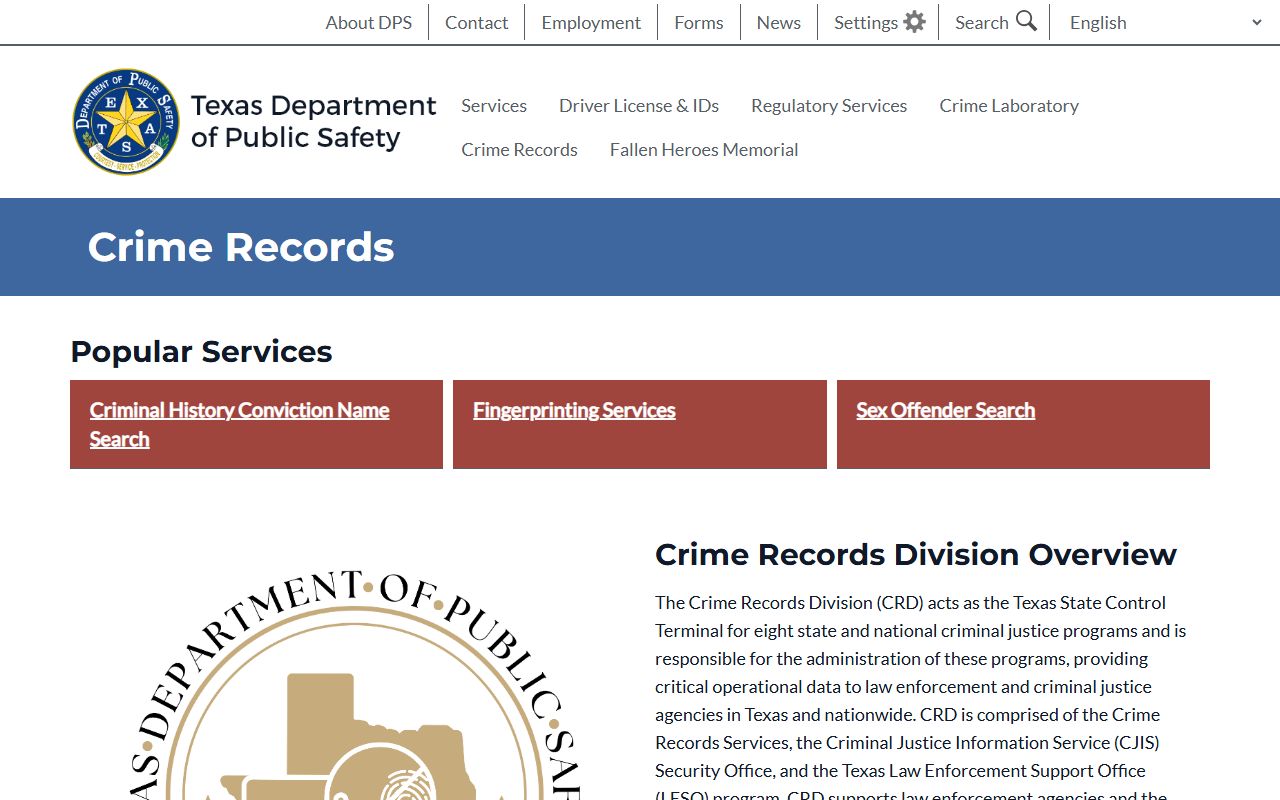
The DPS Crime Records Division acts as the Texas State Control Terminal for eight state and national criminal justice programs, linking local booking data to federal FBI systems.
The Texas Department of Public Safety Crime Records Division (CRD) is the central repository for criminal history in Texas. CRD collects data from local law enforcement agencies and courts, builds the Computerized Criminal History (CCH) system, and sends records to national databases at the FBI. The CCH contains conviction records and deferred adjudication cases reported from across the state. Arresting agencies, county attorneys, and courts are required by law to report criminal history to DPS.
The DPS public criminal history name search at publicsite.dps.texas.gov covers over 25 million criminal records. Each name-based search costs $3.00. The database only includes convictions and deferred adjudication, not arrests that did not result in conviction. For a personal review of your own record, visit the DPS personal criminal history page. A personal name-based search costs $10 by mail or $3 online. A fingerprint-based search costs $15 plus the fingerprint submission fee and gives you the most complete picture.
For personal record review, submit an electronic fingerprint request through IdentoGO at 1-888-467-2080, or mail a written request to DPS Crime Records Division, PO Box 4143, Austin, TX 78765. Call (512) 424-7256 for questions about specific records.
Texas Public Information Act and Arrest Records
The Texas Public Information Act, Government Code Chapter 552, is the legal foundation for public access to booking releases and arrest records in Texas.
Under Section 552.108, law enforcement agencies may withhold information that would interfere with an active investigation, but basic booking data including name, charges, and arrest date must be released to anyone who asks.
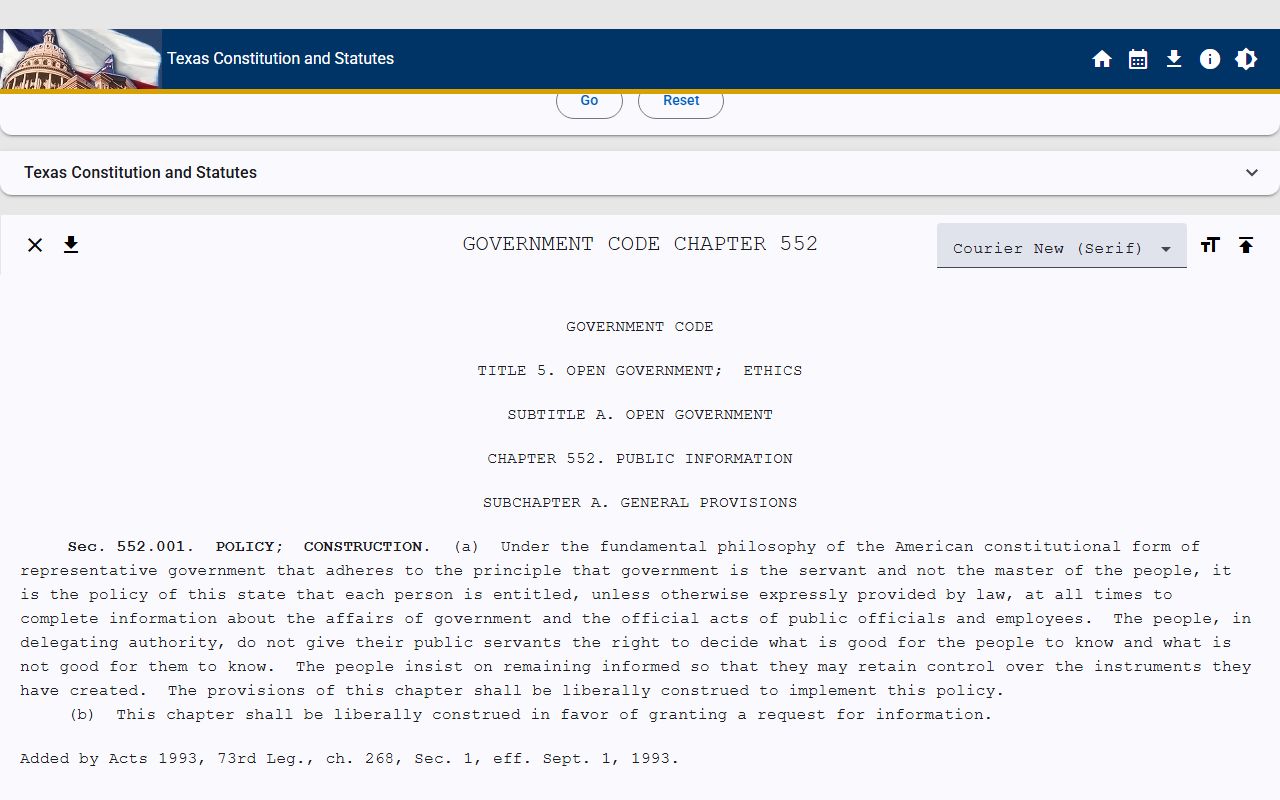
Section 552.001 states that it is the policy of Texas that each person is entitled to complete information about the affairs of government and the official acts of public officials. Section 552.021 requires that public information be available during normal business hours at a minimum. Under Section 552.002, public information means any information collected or maintained in connection with official government business. This covers booking logs, jail rosters, and arrest records held by county sheriffs.
Standard copy fees under Texas Attorney General guidelines are $0.10 per page for paper copies after the first ten pages. Labor charges run $15 per hour after the first hour when staff time is required to compile records. Overhead charges may not exceed 20 percent of labor charges. Electronic records are charged at the actual cost of the media. The Texas Attorney General's office issues binding decisions when agencies and requestors dispute whether information must be disclosed.
Government Code Chapter 411 establishes the DPS Crime Records Division's authority to manage statewide criminal history data. Section 411.084 defines criminal history record information and governs its dissemination. Under this framework, booking data flows from local jails to the DPS CCH system and then to national FBI databases.
Finding Booking Releases with reSearchTX
The reSearchTX system at research.txcourts.gov is a statewide court records portal operated by the Texas Office of Court Administration, covering e-filed case documents from all 254 counties.
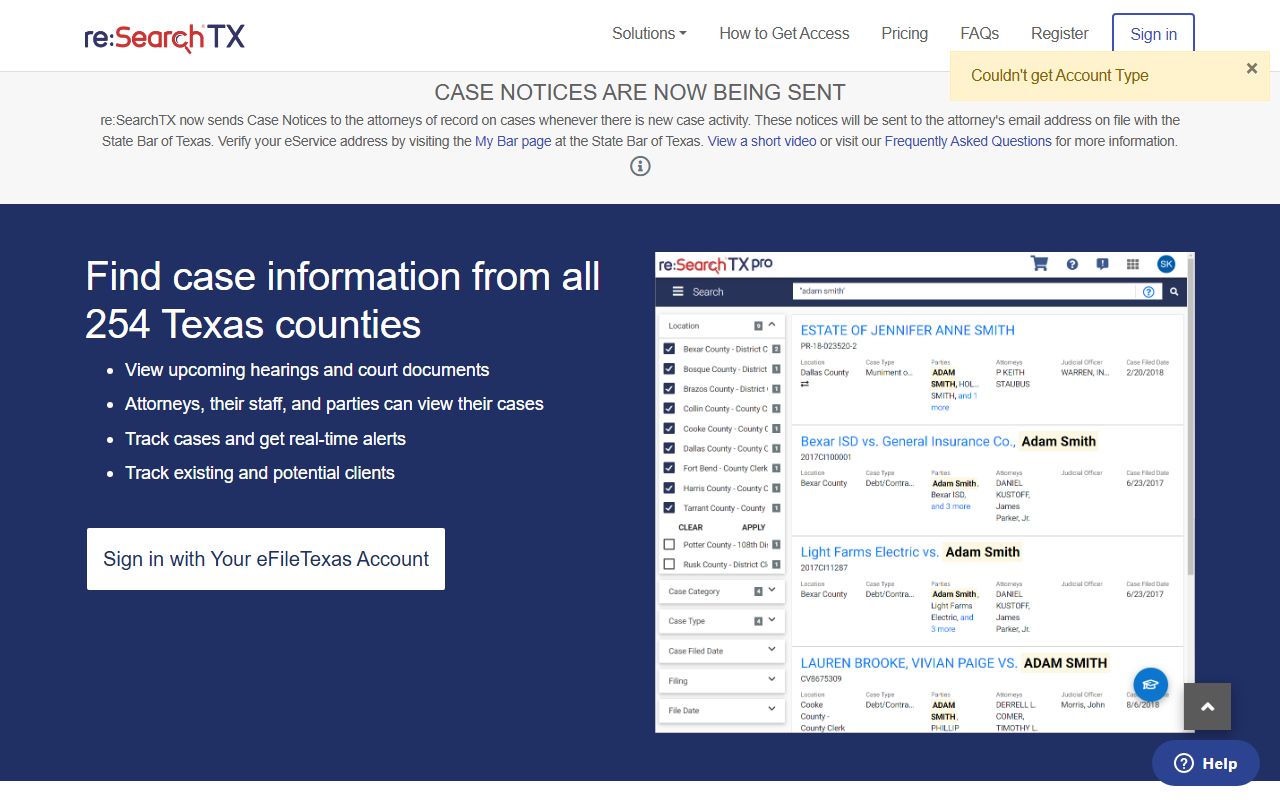
reSearchTX is comparable to the federal PACER system and lets judges, attorneys, and the public find documents e-filed in any Texas county court, with some counties offering integrated access to more documents beyond basic e-filings.
reSearchTX is most useful once a criminal case has progressed past the initial booking stage and documents have been e-filed in court. You can search by party name, case number, or case type and view charging documents, docket entries, and case status. Documents cost $0.10 per page to download, with a $6.00 maximum per document. After purchase, documents remain viewable for 30 days. Some restricted case types are not available to the public, including certain sealed matters.
For the actual booking release or current jail roster, the county sheriff's website or jail portal is the better starting point. reSearchTX complements that search once you have a case number or need to check the status of criminal charges tied to a booking.
The Texas Office of Court Administration also manages the OCA Protective Order Registry, launched under Monica's Law in 2020, and the TOPICs system at topics.txcourts.gov for public access to citations and local court rules.

The Texas OCA supports e-filing through the eFileTexas system, with nearly 255,000 registered users processing over 25,000 documents per day across all 254 counties.
Expunction and Clearing Booking Records in Texas
Booking and arrest records do not go away on their own. If an arrest did not lead to a conviction, the booking record still exists in county systems and may appear in criminal history databases. Texas law provides two main paths to limit who can see that record.
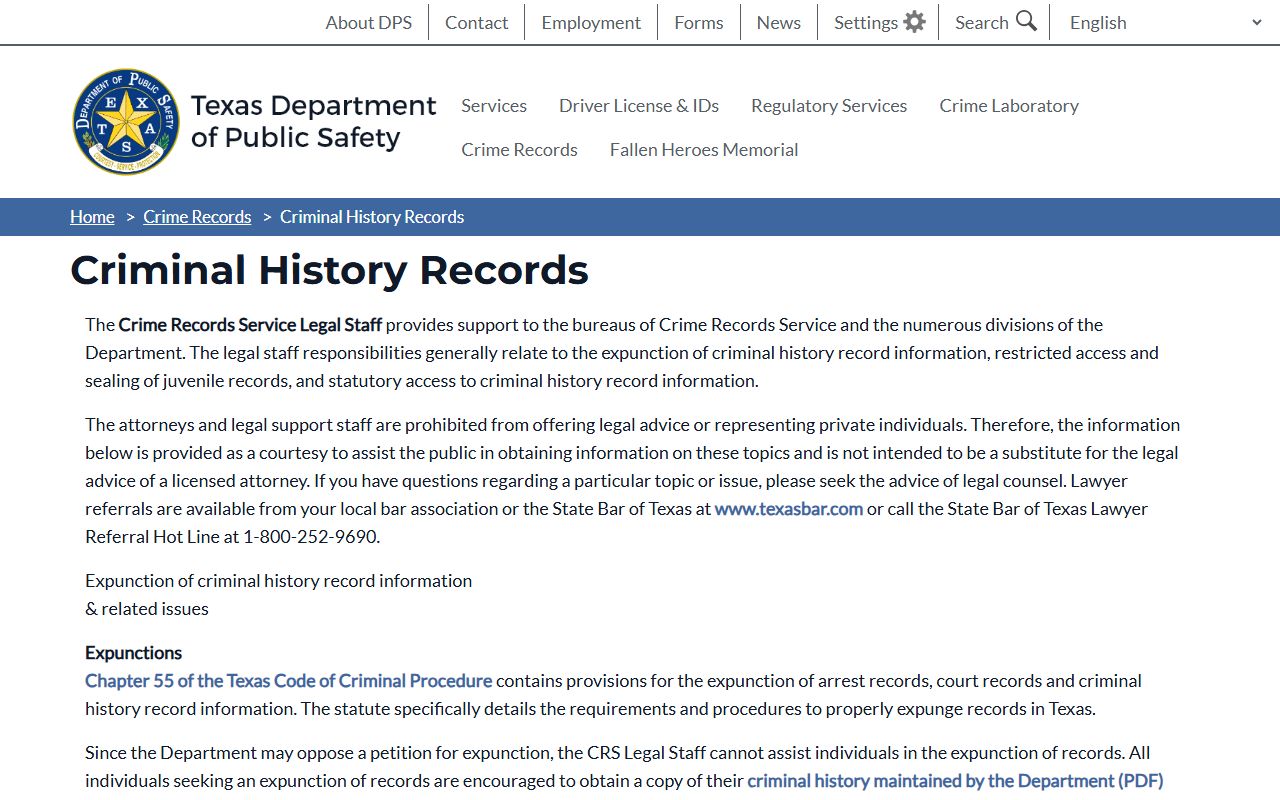
Chapter 55 of the Texas Code of Criminal Procedure governs expunction of arrest records, court records, and criminal history record information. When a court grants an expunction, agencies must destroy or return all physical records. The event is treated as though it never occurred. People who received a discharge without a finding of guilt or whose charges were dismissed may be eligible to petition for expunction. DPS may oppose an expunction petition, so it is a good idea to get a copy of your own record before you file.
The DPS expunction and nondisclosure page explains both options. For nondisclosure, Texas Government Code Section 411.071 allows people who completed deferred adjudication to petition the court for an order blocking public disclosure of their criminal history. The record is not destroyed but is removed from public view. If your identity was used by someone else during an arrest, Government Code Section 411.0421 lets you file a declaration with your county sheriff to flag the misuse.
The DPS Crime Records page has contact information and guidance for starting either process. Both require a court order.
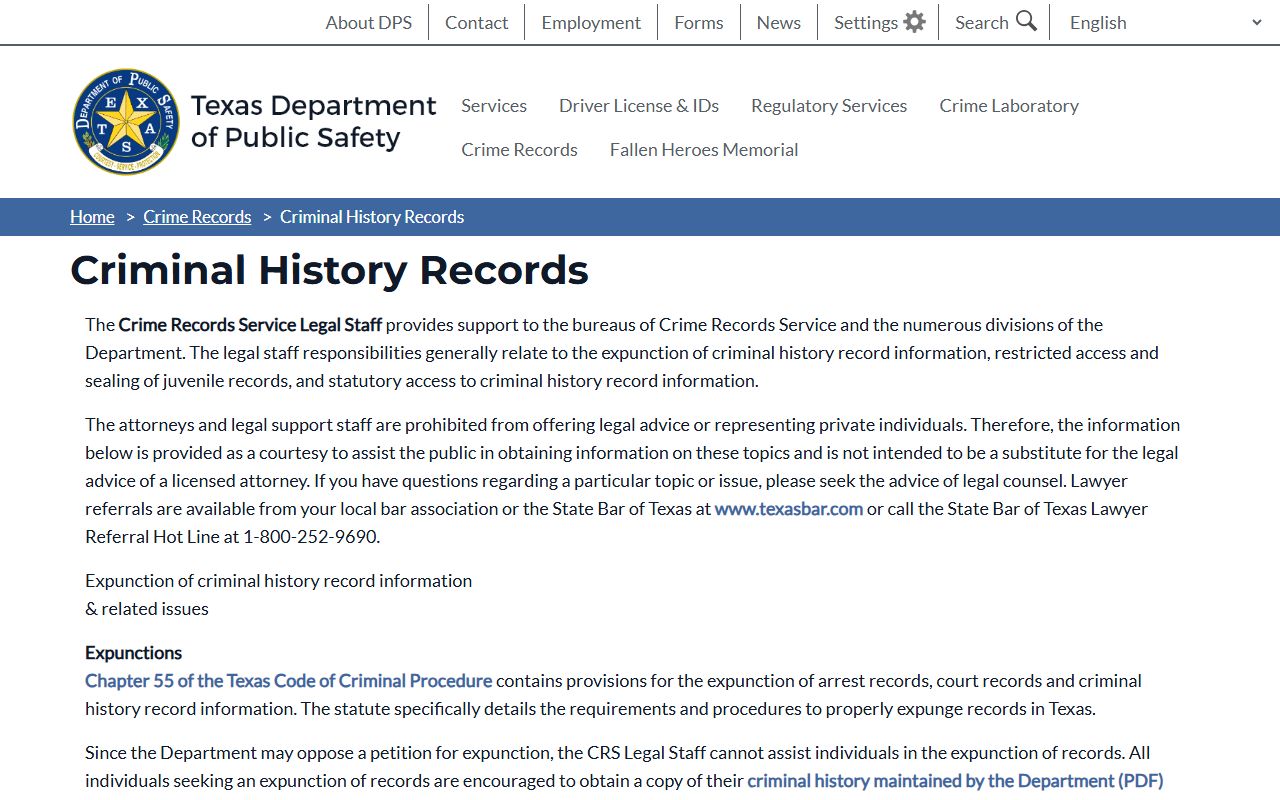
DPS staff cannot provide legal advice on whether you qualify for expunction or nondisclosure; contact a licensed Texas attorney or one of the state's legal aid organizations for guidance on your specific situation.
Texas Sex Offender Registry Search
The Texas Sex Offender Registry at publicsite.dps.texas.gov/SexOffenderRegistry lets you search registered sex offenders by name, address, county, or zip code, with photos and map addresses displayed for each registrant.
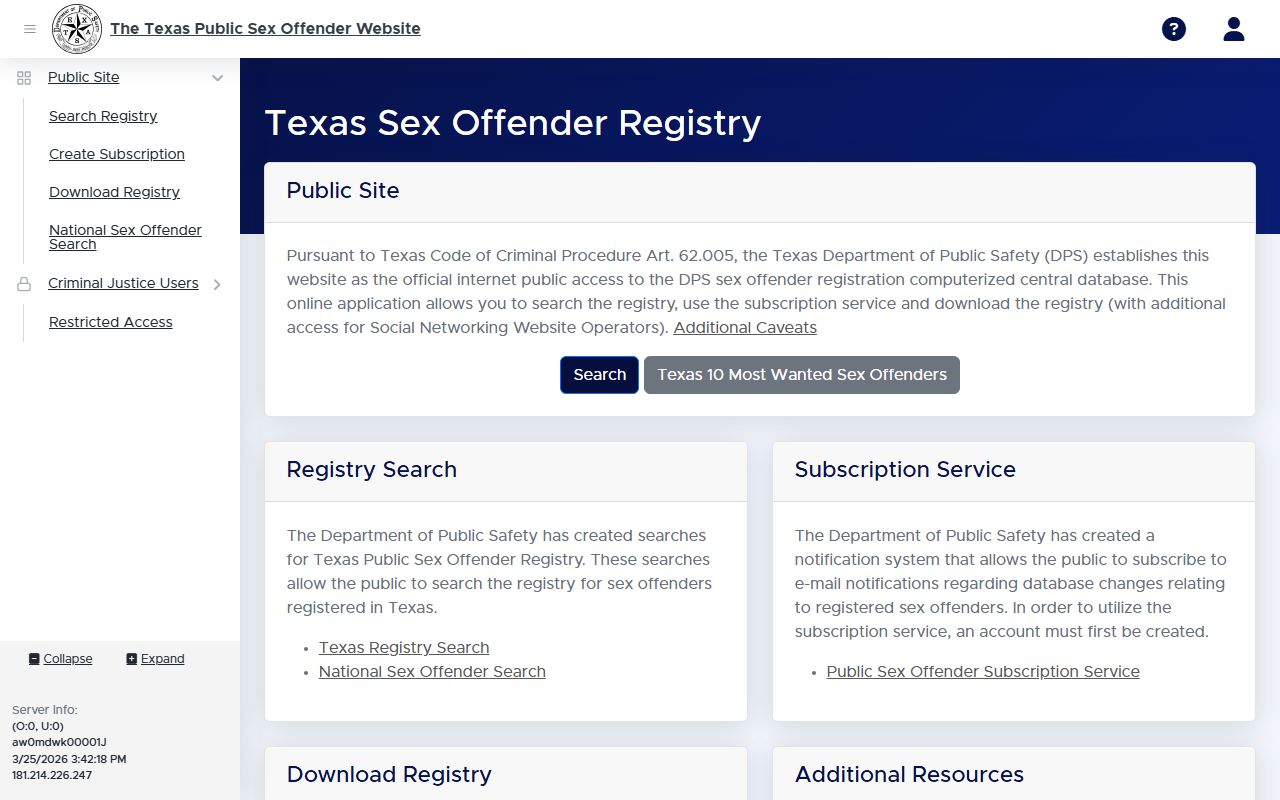
If a high-risk sex offender moves into an area, DPS will notify neighboring residences and businesses about the move, and registration requirements apply retroactively to offenders convicted on or after September 1, 1970.
The registry is maintained by the Texas DPS under Texas Code of Criminal Procedure Article 62. The first registration law took effect in 1991 and was codified in 1997. All registrant data comes from TDCJ, the Texas Youth Commission, or local criminal justice agencies. Registration length ranges from 10 years to lifetime depending on the offense type and severity. For questions about specific registrations, call DPS at 512-424-2800.
Browse Texas Booking Releases by County
Each of Texas's 254 counties has its own Sheriff's Office and jail. Many publish online booking lists, inmate rosters, or real-time release records. Pick a county below to find local jail contact info and booking release access for that area.
Booking Releases in Major Texas Cities
Cities in Texas do not run their own jails in most cases. Bookings go through the county jail that serves the city. Pick a city below to find out where to search for booking releases in that area.